School ERP vs School Management Software: What Is the Difference?
Schools today are responsible for much more than just classroom activities. Students' records for admissions fee, attendance tests reports, pay stubs transport, parent communication and other administrative tasks must be efficiently managed. As schools transition away from the use of spreadsheets, registers and unconnected applications There are two terms that pop up frequently: school ERP and school management software.
However, are they really different? Which is the best in your particular school?
The answer will depend upon the capabilities, capacity and the level of integration your institution requires. Many times modern platforms, the two concepts into a single solution.
What Is School Management Software?
school management software is a platform that is designed to make it easier and more efficient for the daily tasks of a school. It typically focuses on tasks like student management and attendance, as well as fees collection, exams as well as homework, timetables and communication, and reports.
For instance, instead of keeping track of the attendance of students in a physical register, teachers could record attendance online. Administrators can view student data through a centralised dashboard and parents will be notified of important information without relying on printed notices as well as phone call.
The main goal of software for school management is to make regular school activities easier, more efficient and more organized.
The features offered will differ from one provider to the next. Certain platforms might focus solely on academic records and student records and other platforms offer an array of tools for managing finances and administration.
What Is School ERP?
The School ERP (Enterprise Resource Planning) extends the concept by connecting various departments and workflows using an integrated system.
Instead of coordinating admissions costs, attendance exams and payroll, as well as transport and communications on their own In place of managing these separately, an ERP integrates these functions. Data entered into one component of the system could be utilized to facilitate processes in different areas, thus reducing the number of duplicate entries and disconnecting records.
A comprehensive school ERP may include:
Online management of admissions
Management of student information
Attendance tracking
Management of fees and collection of fees
Management of reports and exams
Management of homework and timetables
Payroll and accounts
Management of inventory and library libraries
Management of hostels and transport
Portals for parents and students
SMS and email messages
This unified method allows an ERP especially useful for schools looking to automatize their entire administrative system instead of merely replacing each paper-based process.
School ERP vs School Management Software: Key Difference
The most significant distinction is scale and integration.
School management software is utilized to handle specific administrative and academic tasks. An school ERP typically aims to connect more of processes and departments on the use of a single platform.
Consider it in this the following way:
School Management Software It helps schools manage their activities electronically.
School ERP It connects to manage several school activities with an integrated program.
However, in reality the terms are typically used to refer to the same thing. Modern providers often define their platforms as a combination of school management software as well as school ERP, since they incorporate administrative, academic communication, financial, and academic functions.
Which One Does Your School Need?
The ideal choice will depend on the school's requirements.
Smaller schools with less administrative requirements may begin looking for a basic school management system that covers attendance students' records, examinations, fees and communications.
However, schools that are growing could benefit from a full school ERP system that integrates admissions fees attendance, academics, transportation, payroll library, communication with parents.
The most important thing isn't selecting software that is merely marked with"ERP. "ERP" label. Schools must determine if it actually offers the features and integrations they require.
Why an Integrated Platform Matters
Utilizing separate software for various departments could present a number of challenges. Staff might have to fill in the same student's details repeatedly, administrators could have trouble keeping accurate records while communication between different departments could slow down.
A fully system that integrates school ERP gives an all-in-one source of information. For instance, records of students are able to be linked with exams, attendance, fees as well as parent communications. This will help to reduce the amount of administrative work that is repetitive and also make data more accessible.
A central platform could help improve the experience of administrators, teachers as well as students and parents.
EZSchools: School ERP and School Management in One Platform
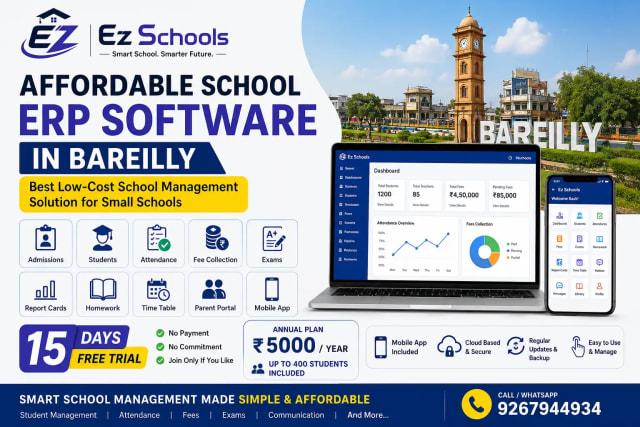
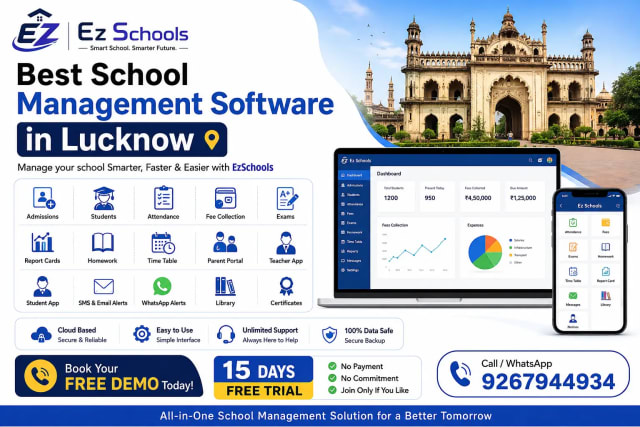
EZSchools incorporates school ERP as well as school management features into a single system designed especially to be used by Indian schools. The system combines admissions and student management the attendance of students, their fees exam results reports, pay-roll transportation, library inventory and parent communication all in one dashboard.
The platform is also able to support Excel spreadsheet data export and import as well as access for parents and students via SMS and email notifications, as well as responsive access across different devices. This allows schools to move from traditional spreadsheets and registers to a central digital system.
Another benefit is its pricing per student. According to EZSchools plans, prices start at Rs5 for each student each month in schools that have 200 or less students, to the rate of Rs2 each month per pupil for institutions that have over 500 pupils using the platform's modules throughout plans.
Final Thoughts
The main difference among schools ERP and school management software mostly comes down to the scope. School management software is focused on digitalizing school-related activities and ERP usually brings a wider array of functions in one system.
If schools are planning a long-term digital transformations, opting for an application that blends both methods can be a viable option. Instead of managing a variety of separate applications, schools could connect their administrative, academic communications, financial and administrative workflows together.
In case your organization is eager to cut down on paperwork, streamline everyday operations, and run everything on one platform Explore EZSchools ' School ERP as well as Management Software and consider asking for a demonstration.